
Raising awareness on World IBD Day
People living with inflammatory bowel disease are being encouraged to speak more openly about the condition as part of World IBD Day on 19th May 2026.
More than half a million people in the UK are living with conditions including Crohn’s Disease and Ulcerative Colitis.
Ulcerative colitis affects the large bowel, while Crohn’s disease can affect any part of the digestive tract. Symptoms can include pain, fatigue, diarrhoea and bleeding.
Jack Fitzwater, who plays for Exeter City Football club, said he was going to the toilet “30 to 40 times a day” before being diagnosed with Ulcerative Colitis.

The 28-year-old said he tried to carry on playing football while hiding how unwell he had become: “Trying to hide things was horrible”.
“Mentally it was really tough as well as physically and it definitely affected the people around me as well. There were times I would stop at motorway services and sprint to toilets”.
He added: “I looked really, really ill, my face was drawn in, I looked weak and I’d be rushing in and out of places trying to find toilets”.
The defender for the now League Two side is supporting the ‘Know Your Sh*t’ campaign and the RAPID-IBD study, which is an initiative to improve diagnosis rates across Devon.
Ellis Russell, from Honiton in East Devon, was diagnosed with Ulcerative colitis at the age of 19 after developing toxic megacolon, a serious complication which left doctors giving her a 20% chance of survival.

She recalled the period before diagnosis: “By the end of September I could barely walk. I was really poorly and we still didn’t know what was wrong.”
After emergency surgery, Ellis woke up with a stoma bag, which she later had reversed.
“It saved my life,” she said. “It took a lot of getting used to but I was lucky.”
Now, almost 20 years later, she said the condition still affects her daily life through fatigue and food intolerance: “I think chronic fatigue is a massive part of IBD - one day you can feel absolutely fine and the next day you’re not.”
For 21-year-old Fin Glass, symptoms first appeared while he was at school.

The aspiring student pilot looked back at the early days of suffering from Ulcerative Colitis: “Everyone was outside having fun and I just had no energy, I was always on the toilet and I just couldn’t do anything really.”
After years of aviation training and passing many of his pilot exams, he said flare-ups linked to IBD may now affect parts of his future career, “you create plans and then suddenly you can’t do anything.
“You might have a really good period and then the symptoms come back again.”
Researchers at the Royal Devon University Healthcare NHS Foundation Trust and the University of Exeter are working to improve diagnostic rates through the RAPID-IBD study, which offers free testing kits to people aged between 16 and 49 across Exeter postcodes.
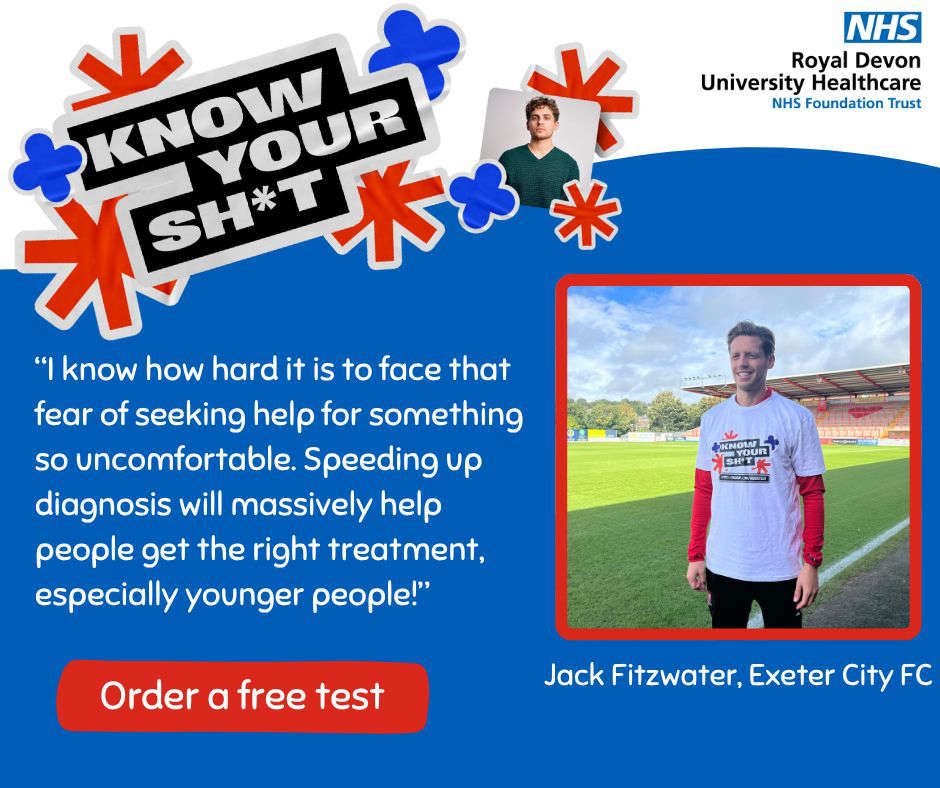 (Image courtesy: Royal Devon University Healthcare NHS Trust)
Doctors say many people delay seeking help because symptoms can feel embarrassing or difficult to talk about.
Many campaigners hope greater awareness around Inflammatory Bowel Disease will encourage more people to recognise symptoms earlier and seek support sooner.
 Torbay councillor resigns from ‘champion’ role over Mayoral row
 Go-ahead for new Exeter housing development
 Plymouth foster home campaign launched
 The English Riviera Airshow 2026 is approaching
 Shoes found in major search for missing teenage boy
 Reform win Tiverton Town Council by-election