It's been compared to other areas across England
The majority of Devon’s flood defences are in good repair and above the required standard, according to a national analysis.
All of Devon’s councils have 10 per cent or fewer of their flood defences listed as ‘below required condition’ (BRC), according to exclusive figures obtained by the BBC Shared Data Unit.
Those numbers show that, as of 20 October this year, 8.6 per cent of the 98,466 defences inspected in England by the Environment Agency fell below their required standard.
About 6,500 of those below condition are considered ‘high consequence’, meaning they are meant to protect multiple homes or businesses.
While the Department for the Environment, Farming and Rural Affairs (Defra) says the situation has improved since the same time last year following record levels of investment, stark disparities remain at local authority level
However, Devon appears to have fared strongly.
In Torbay, 19 of its 193 flood defences were listed as BRC, but none of those are high consequence.
North Devon only had 6 per cent as BRC – which is equivalent to 57 of its 924 across the district. A total of 35 of those were seen as high consequence.
Plymouth also sat at 6 per cent, with 18 of its 311 flood defences being BRC, and all of those 18 were considered high consequence in the data.
But that compares to the 244 that were below required condition in worst-placed East Suffolk out of its 1,125 – and 160 of those below standard ones deemed high consequence.
The remaining seven councils in Devon covered by the data – East, Mid, West Devon, the South Hams, Teignbridge, Torridge and Exeter – had a range of 5 per cent to 1 per cent as BRC.
East Devon had 22 of its below condition flood defences listed as high consequence, compared to Exeter that only had one.
However, East Devon has been active in terms of shoring up major flood defences, including rebuilding the sea wall in Exmouth. It is also currently consulting on its Budleigh Salterton beach and cliff management plan, which residents can respond to until 16 January.
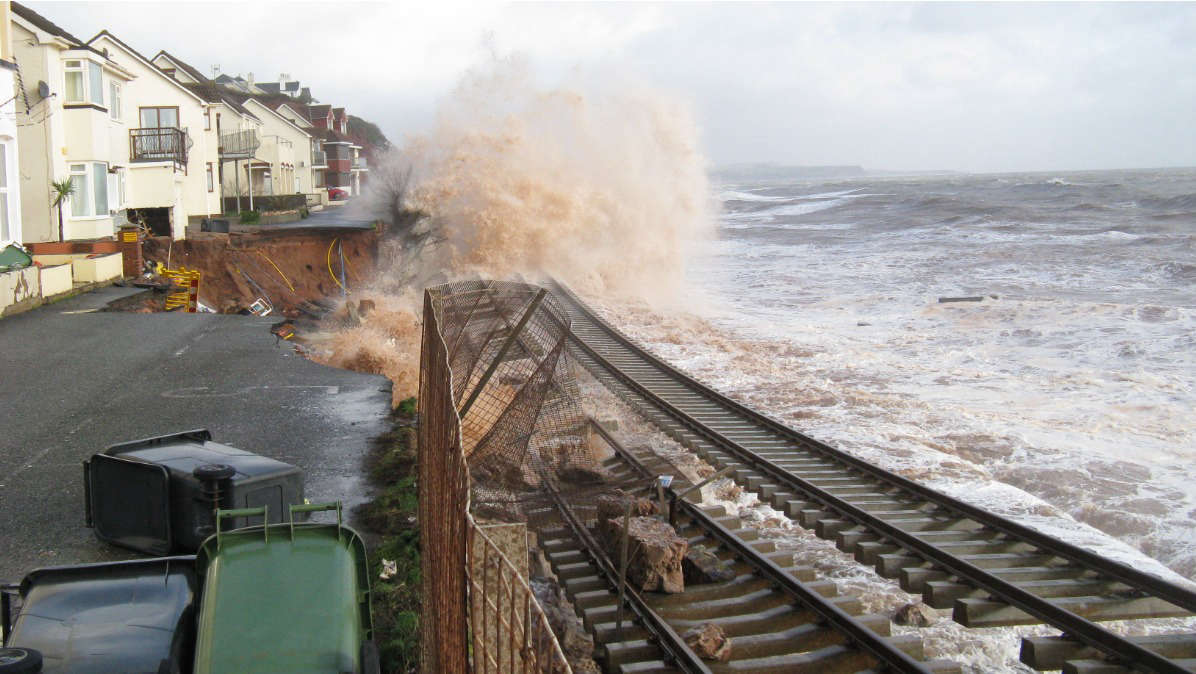
While Devon has emerged well from the analysis of flood defences, it has had some high-profile flooding events.
A 2021 report by Devon Climate Emergency stated that “flooding and coastal erosion also present a very serious risk to public assets, critical infrastructure and transport across Devon, Cornwall and the Isles of Scilly”.
“In February 2014 a failure of the seawall at Dawlish resulted in the closure of the main line railway to London for two months, the resultant repairs and other strategically planned improvements to increase rail resilience between Exeter and Newton Abbot will cost tens of millions of pounds to deliver,” it said.
That study concluded that 130,000 homes across Devon, Cornwall and the Isles of Scilly were at risk of suffering a flood event with a 0.1 per cent chance of occurring every single year, but a significant proportion of those were at risk of “much more frequent flooding”.
Elsewhere, the Devon Resilience Innovation Project (DRIP), which includes experts from the University of Exeter and counts some of Devon’s councils as members, won a national award earlier this year at the Environment Agency’s Flood & Coast Excellence Awards.
The project is running from 2021 until 2027, working with 19 organisations to improve resilience to flooding in 26 communities across Devon.
Many of the communities selected would not typically be high priority within the local flood risk management strategy due to the low numbers of properties at risk.
It is a unique project to help neighbourhoods be better prepared for and able to recover more quickly from flooding by improving community resilience.
The BBC’s Shared Data Unit said its research showed winters are getting wetter, according to the Met Office.
Six of the 10 wettest winter half-years (October to March) for England and Wales have been in the 21st Century so far, it said.
In April, Floods Minister Emma Hardy told MPs that 3,000 of the Environment Agency’s 38,000 high-consequence assets were in the “poorest condition on record” following “years of under-investment”.
The Environment Agency’s target is for just 2 per cent of its high consequence defences to be below target condition. The current figure is near 9 per cent.
 Consultation underway on controversial cycles-only Exeter street
 New bikes for hire are coming to Exeter
 Man wanted following stalking report
 Pro skydiver dies at Devon airfield
 Torquay United searching for new manager
 Torbay councilors clash over street cleaning and signage